


Activities in Murchison Falls National Park | What to do in Murchison Falls National Park
There are many activities in Murchison Falls National Park. Uganda safari enthusiasts to the park have a number of opportunities to indulge, including ultimate game drives, boat cruises, cultural experiences, chimpanzee trekking , birding and many more as detailed below.
Visit Top of Murchison Falls
This is the main attraction of the park from which it gets its name as well as the river Nile with crocodiles and hippos on the riverbanks. The most magnificent view of the waterfalls is on the top of where the sight and sound of the Nile are roaring through a wide area.
The site can be reached either by car and a 30-minute climb or by leaving the Paraa launch boat on a cruise.
Game Drives
The park is also composed of woodland, just like other savanna parks in Rwanda, Kenya and Tanzania; wetland; and savanna as well as the tropical forest that is well known to be a habitat for different bird species and mammals. Among the mammals, many can be spotted, including the lions, hippopotamuses, Rothschild’s giraffes, warthogs, Cape buffalo, Uganda kobs, Jackson’s-hartebeest and elephants.
Game drives take place early in the morning and a tourist is able to see plenty of game. Nyamsika Cliffs is where one can enjoy a picnic, the view and gaze at elephants and other wildlife on the green grassy hillsides and river below. Game drives are exquisite when accompanied by a tour guide. The best time for a game drive is during the dry season.
Murchison Falls National Park Boat Cruise
The Murchison Falls National Park boat cruise is an impressive experience with lots of fun and entertainment among other activities done within the park. In the park, a boat cruise is done to the bottom of the top of the falls as well as the Albert Delta boat cruise, which is done in two sessions: the morning boat cruise starts at 9:00am and the afternoon boat cruise starts at 2:00pm.
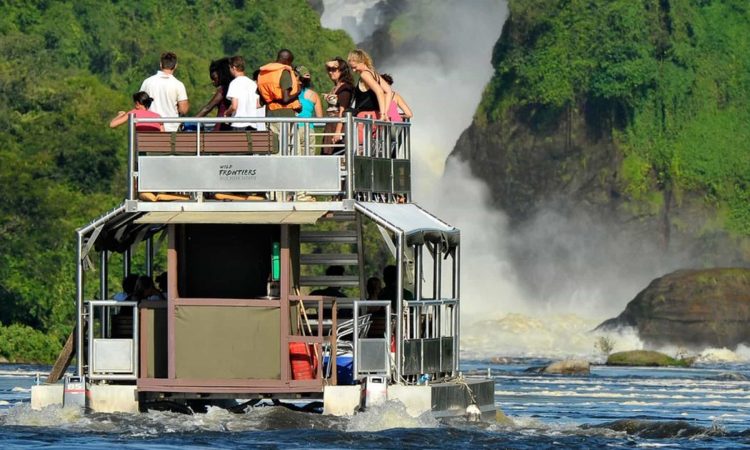
A lot of visitors come to Murchison Falls National Park with the main aim of seeing the most powerful waterfall. However, that turns out to be the complement to the terrific boat cruise along the Victoria Nile–River Nile. Since there are two types of boat cruise in Murchison Falls national park as explained below,
The bottom of the falls boat cruise
The bottom of the falls boat cruise is the most exciting activity. As you begin your boat cruise at the starting point, the boat sails near the hippos and the crocodile pool and hippo pool, where you can view lots of hippos floating on water and water birds like cattle egrets and white egrets, among others. It’s quite a terrific ride in the midst of the beauty of the Nile. The ride is more interesting with a couple of bottles of cold drinks with the friends.
The boat cruise gives a gainful opportunity for you to have a beautiful view of the Nyamusika cliffs, nature around and wildlife species such as buffaloes and elephants, among others. Then you will be able to cruise near the bottom of the falls with a spectacular view of Devil’s Cauldron.
Though the boat doesn’t get close to Devil’s Cauldron, you will also be able to see Nyamusika cliff, which is rugged with holes formed from the force with which the water droplets hit the ground from the cliff, thus forming holes to act as a home for bird species, where you can be able to see numerous bird species in the nearby trees, and the better way to see them is by use of binoculars since they are small.
The Albert Delta Launch Cruise
A boat cruise to the Albert Delta starts from paraa and the boat slowly sails on the gently flowing Nile waters after losing its power from the falls’ plunge pool. Then from here the boat cruise sails down the stream where the river splits up to create several floating islands of papyrus zones. The Albert Delta is where one can be able to seek out the prehistoric shoebill stork.
The shoe bills are fishers. Though the floating water vegetation could be a challenge, the hippos come in to help out because the shoebills tend to follow the hippo trails, and it becomes easy for them to fish for their food. The delta boat cruise is quite amazing and terrific, referred to as the sun downers trip” downstream.
The launch trip upstream from Paraa gives a gainful view of the display of wildlife and a memorable frontal view of the astonishing waterfalls. The launch or boat cruise departs at 9 am and 2 pm daily and takes a three-hour ride.
However, the boat cruise experience is recommended for bird lovers, mostly for those who do a morning cruise downstream to Lake Albert’s Nile Delta. Along here, you’re able to sightsee the elusive shoebill. It is a four- to five-hour return voyage where you can have a great chance of seeing a variety of wildlife, such as hippos, elephants and numerous birds.
You can also be able to enjoy a sundowner boat cruise at around 5:30 pm, offering a perfect view of an equatorial sunset reflected on the river.
What is the cost of a boat cruise in Murchison Falls National Park?
A boat cruise in Murchison Falls National Park goes for USD30 per person, which is exclusive of refreshments. However, drinks are also sold on the board at a reasonable fee.
When is the best time to go for the boat cruise?
The best time to do a boat cruise is during dry season, which starts in December to February and June to September. Murchison Falls is located in the hottest regions of Uganda, with the temperature ranging between 25 and 35 degrees Celsius.
Birdwatching
Bird species commonly seen between Paraa Rest Camp and the ferry crossing are the spotted mourning thrush, vitelline masked weaver, silverbird, bluff-bellied warbler, blue-napped mousebird, chestnut-crowned sparrow-weaver, black-headed gonolek, green-winged ptyilia, and black-headed batis. This is the best site for the localized white-rumped seed-eater.
Common nocturnal species in the area include the following: Verreaux’s owls and nightjars such as long-tailed and pennant-winged nightjars, which are usually watched between the months of March and September.
Also available is the amazing standard-winged nightjar watched from November to February. Other bird species include the African Skimmer, White African fish eagle, long-toed plover, Gray Crowned crane, Goliath Heron and more

Nature walks
Tourists get to explore the wild on foot while in the Murchison Falls conservation area. There is a trail at Paraa that winds throughout low hills, gullies and forest around the river. Nature walks happen at the top of the falls, KaniyoPabidi and Rabongo Forest. Rabongo Forest Ecotourism Centre is located on an island of tropical river forest in the southeast of the conservation area.
Savannah grasslands surround the forest. With a tour guide, one can explore primates like the red-tailed monkeys, black & white colored monkeys, chimpanzees, birds, trees and medicinal plants. Kanio Pabidi is a serene area of natural forest within Budongo Forest Reserve, where you can walk beneath mature mahogany and ironwood trees.
Chimpanzee tracking is the most famous activity. You certainly see many forest birds, including the chocolate-backed kingfisher, the white-thighed hornbill, and Puvell’s illadopsis, found nowhere else in East Africa! Kaniyo Pabidi is on the Masindi–Paraa road, 8 km from Kichumbanyobo gate.
Buligi Peninsula
The best way to have prime game viewing in the park is to do it in the Bugungu Peninsula, a triangle of grass bounded by the Victoria Nile that connects Lake Albert and the Albert Nile flowing out of it. Where tourists expect to see species of buffalo, elephants, antelopes and giraffes, keep your eyes open; you might come across lions and leopards if you’re lucky. There is a game track at the Delta point where the Nile flows north out of Lake Albert, a very convenient place to stop for refreshments and view waterbirds offshore and distant hippos.
Visitors can choose to do a hot air balloon tour to explore the plains north and west of Paraa in a hot air balloon.
Heart of Murchison
This area is located in the southern part of Murchison Falls national park covered by bush and forest, with a delightful tract of savanna rolling down to the river Nile from the Rabongo road, which is centered beside the park. Along here on the game track, expect to see herds of Uganda kob and other species. Furthermore, the area has turned into a prime location for seeing lions, among others.
Visiting the top of the falls is worth it because of its powerful falls with splashing waters.
Both birders and nature lovers can simply enjoy short treks beginning from Sambiya River Lodge or Mubako Junction or encounter the hidden treasures on foot along the north bank from Paraa, passing the Emmy River. All walks done within the park can take one and a half to two hours.
Sport fishing in Murchison Falls
This is quite rewarding activity with great opportunities to land a large Nile Perch, Cat fish and other caught species
During sport fishing, you get a chance to see the biggest edible fish species, the Nile perch; you can also catch other fish like catfish, tiger fish, electric catfish, and the most delicacy for the fishermen, tilapia. However, the sport fishing in Murchison Falls National Park is not regular fishing for food; rather, it is based on a catch-and-release basis.
In Murchison Falls National Park, there are a number of fishing spots; you can either choose to fish on a boat or beside the Nile (on the river banks) and the park has mainly two fishing spots, namely, one near Paraa located below the Murchison Falls and the other below the Karuma Falls (at Chobe Safari Lodge).
Spot fishing in Murchison Falls can be done anytime around the year and the large catfish and Nile perch can be caught all year round. Fishermen credit that the best catches are seen early in the morning and late in the day. The best results for fish are when the water level is low since the water is clearer, and that is during the dry and shadow season from mid-January to early April. And fish feed more when weather conditions vary dramatically, especially at the start of the rains.
Chimpanzee tracking
Chimpanzee tracking is quite an exciting and unforgettable experience done in Budongo Forest, a home of mahogany tree species, birds and primates. Chimpanzee tracking starts in the morning with a guide who leads you to the tracking trails in search of them, an activity that can last 30 to 6 hours depending on where they were last seen the previous day. Once they are located, an hour is given to the trackers to observe their way of life in the jungle, watching them playing, grooming their younger ones, swinging on the tree branches, feeding, and so on.
The largest recorded caught Nile perch weighed 113 kilograms and the largest catfish weighed 45 kilograms landed near the Nyamusika cliffs. Tourists are recommended to use “UWA” guides, the Uganda Wildlife Authority, who lead them to the best fishing spots. Fishing permits are sold at a small fee.
Hot Air Balloons in Murchison Falls National Park
This is the best activity to enjoy the park’s species in an aerial view, with a bush breakfast and sunset—a very fantastic experience.
Culture encounter
During a cultural encounter in the park, you can visit Mubako, a small craft shop that sells carved wooden sculpture and handwoven items made by the local community. You will also be entertained by the local cultural groups with vibrant songs and dances around the campfires of local lodges, well accompanied by the sweet sounds the adungu
Murchison Falls National Park Distance from Kampala
The distance from Kampala to Murchison Falls National Park is not so long, despite the fact it is located in the northern part of Uganda. Many know that the northern Uganda region is a long hours’ drive but just know that Murchison Falls National Park is not far away from Uganda’s capital, “Kampala.” “The park is easily accessed either by road or by air.
By road transport from Kampala, you will use Bombo Road and then connect to the Gulu highway pass through Migera, Kafu and Masindi. From there, drive a few kilometers to access the park. In about a 4- to 5-hour drive, we recommend you use a 4×4 wheel drive. Another option is you can choose to fly with a domestic flight from Entebbe International Airport to the Pakuba airstrip within the park.
Facts about Murchison Falls National Park
Murchison Falls National Park is one of the UNESCO heritage sites, managed by the UWA (Uganda Wildlife Authority), and was established in 1952 as a national park to protect wildlife species that dwell in a vast lowland covering 3840 square kilometers, which is bisected by the world-known river Nile, or “Victoria Nile,” in Uganda. The park lies in the northwestern region of Uganda, from the shores of Lake Albert spreading around inland areas around the Victoria Nile and Karuma Falls.
Murchison Falls National Park Birds
Murchison Falls National Park is one of the best stopping areas in Africa to encounter numerous bird species, mainly the prehistoric-looking shoebill stork. The best way to encounter birds is almost guaranteed on a boat trip along the Victoria Nile towards the Lake Albert delta.
However, a boat trip is one of the most popular; in fact, it’s great for checking off many water-associated birds since the park has remarkable checklists that contain more than 450 bird species in total. Of which the migratory birds are always present, starting from November to April.
Some of the water birds to sight during the boat trip include cattle egrets, white egrets, African darters, silver birds, black-billed barbet, Martian eagles, long-tailed nightjars, weaver birds, Abyssinian ground hornbills, Senegal thick-knees, secretary birds, and many more.
Even though the rare shoebill stork in Murchison is best seen when you take a boat cruise which can be sighted along the banks of the Nile and if you tend to cruise near the bottom of the falls, you will be able to spot the highlight of water bird species that can be seen in thickets and woodland around the river banks as well as Nyamusiki cliff a home to a variety of birds such as white egrets, pied giant malachite, grey herons, lesser flamingos, Verreaux’s eagle owls, white-tailed black cockatoos, marabou storks, greater flamingos, African fish eagles francolin, woodpeckers, warblers, ducks, and geese, as well as the rare shoebill stork, among others.
Birding on a boat cruise is one of the most exciting experiences for tourists on Uganda safari tours. On your birding tours always add Murchison Falls National Park to your checklist itinerary.
List of birdlife to see in Murchison Falls National Parks: They include the following: Black-headed gonolek, African quail finch, Abyssinian ground hornbill, African jacana, black-billed barbet, speckle-fronted weaver, squacco heron, white-browed sparrow weaver, shoebird, red-throated bee-eater, silver bird, swamp flycatcher, piapias, Goliath heron, eastern grey plantain eater, Denham’s bustard, blue-headed coucal, palm-nut vulture, malachite kingfisher, giant kingfisher, black-headed lapwing, saddle-thick-knee, red-winged grey warbler, saddle-billed stork, secretary bird, African jacana, pied kingfisher, among others. The best spotting areas are Lake Albert delta, kaniyo pabidi forest Paraa and Red Chill through the dry thorn shrubs
Budongo Forest is also home to a birding paradise; unlike the chimpanzees, birds of this area can be encountered along guided nature walks. The forest sits on the premises of Murchison Falls national park and it harbors about 360 species of birds with 2 endemic species, including olive-breasted greenbul, lemon-bellied crombec, little green sunbird, crowned eagle, grey-headed sunbird, blue-breasted kingfisher, brown twin-spot, Cassin’s hawk eagle, African dwarf kingfisher, black-eared blue-breasted kingfisher, Ituri batis, chestnut-capped flycatcher, chocolate-backed kingfisher, and crested guinea fowl, among a few.

Lake Albert delta
This is also a great location for sightseeing various birds on a Ugandan birding safari in Murchison Falls, which can be seen in hiding shrubs and front green vegetation in the water. Birds to see include pied malachite, francolin, grey heron, woodpecker, warblers, ducks, geese, kingfishers, shoebill storks, water egrets, grey herons, pied grant malachite, and many more.
Best time for Birding in Murchison Falls National Park
The birding in Murchison Falls is best done from January to March; it can be low tourist season but there is an abundance of birding activity. December to February receives the least rain, while April to May and August to October receive the most rain, although the heavy rains might result in a delay of spotting time because hiking trails can be slippery as well, limiting your great birding moments.
What should you carry on your birding site?
Bird lovers expect to have a birder’s guidebook, a pointer, a pair of binoculars, sunglasses, sturdy shoes, hats, flashlights, wide-brimmed sunglasses, a camera, a backpack, a pair of binoculars, and enough mineral water bottles, among others.
Where to stay on Uganda birding safari
While on a safari in Murchison Falls National Park, you can sleep in classic accommodation facilities ranging from luxury to budget; the choice depends on the tourist’s wallet. Such lodges are Nile Safari Lodge, Chobe Safari Lodge, Murchison River Lodge, Paraa Safari Lodge, Parkside Safari Lodge, Pakuba Safari Lodge, Geo Lodges, Amuka Safari Lodge, Baker’s Lodge, Sambya Safari Lodge, and Murchison Tree House, among others. They offer quality and comfortable amenities. They all provide memorable views of the beautiful nature.
Visit Murchison Falls National Park on your next safari, most especially bird lovers, since it boasts a wide range of rare and beautiful bird species, thus ranking Uganda as the best birding destination in the East African countries.
Getting to Murchison Falls National Park
The distance from Kampala to Murchison Falls National Park is about 305 kilometers and only a 4- to 5-hour drive from the city center when you use the private transport means. Please take note, a wheel drive “4WD” is an ideal option for self-driving to the park since the road inside Murchison is a loose-surface road that is well-maintained. Nevertheless, the duration of travel is mostly affected by the nature of the road inside the park.
The distance to the park is also dependent on which part of Murchison you want to visit. Murchison Falls National Park is bisected by the Victoria Nile thus making north and south. The southern entrance gate connects your way to the Paraa region. You can decide to pass via the Kichumbanyobo gate to Paraa through Pabidi Forest, which covers 85 kilometers from Masindi.
Option: You can pass via the Bugungu gate, which covers 135 kilometers and more, though the scenic view is rewarding and sights through Budongo Forest are breathtaking. It also gives a great view of the rift valley escarpment together with the Congo Mountains, thus making the long ride shorter and gainful with sights.
You can choose to use the northern side of the Murchison Falls National Park, which leads to Chobe Safari Lodge through Wankwar Gate, mubako and Tangi Gate north of the Nile River. You can still reach the northern gates via the Kampala–Pakwach road. The Pakwach road crosses the Nile at the Karuma Falls bridge. Karuma Falls is where Uganda’s best power station is constructed that supplies electricity to certain places in Uganda.
The northern side is 260 kilometers from Kampala and it is overflowing with visitors traveling from and to Gulu or traveling from Kidepo Valley National Park.
Murchison can also be reached by air transport, meaning the easiest and shortest means of transport to access the park is through Pakuba Airfield, which is 19 kilometers north of Paraa, which is in the southern part of the park.
Then Northern Park is also reached through Chobe Airfield to the east of Murchison Falls National Park and Bugungu near the falls on the southern side of the park. Both charter and scheduled aircraft are available at Entebbe International Airport or Kajjansi, which is located 46 kilometers away from Kampala.
All you need to start booking in advance with domestic flights by the help of tour operators and airlines to book include Aerolink, eagle air and others. All the bookings are handled with the help of the tour operator while on a Uganda safari.
